

Our Process.
Driven by your challenges. Proven with real users.
K.I.N.G. Methodology®
It was specifically designed to build software with real business impact
Introduction
Our process is built on The K.I.N.G. Methodology, created by our CEO Rubén Ximénez in 2023 after two decades of diverse project experience, particularly in digital. It aligns company goals with user needs, moving from vision and design through development, and finally optimizing sales and marketing to attract users or drive direct revenue.
I. Knowledge
discover/PLANII. Ideation
DESIGN/PROTOTYPEIII. New Technology
DEPLOY/MEASUREIV. Growth
REVENUE GROWTHThe K.I.N.G. Methodology is a structured, evidence-driven approach for building digital products that actually work in the real world. It was created to solve a recurring problem: companies often design and develop software guided only by internal expectations, limited assumptions, or market pressure. The result is predictable—poor adoption, wasted investment, frustrated users, and products that never achieve their intended impact.
K.I.N.G. takes a different stance. It breaks the process into four interconnected stages—Knowledge, Ideation, New Technology, and Growth—each designed to balance business goals with user needs, test assumptions before investing heavily, and ensure the final product delivers what it promises. Instead of linear “design-build-launch,” K.I.N.G. operates as an iterative loop grounded in research, prototyping, validation, and deliberate execution.
Its central philosophy is straightforward: success comes from balance. A product that only serves the company fails users; a product built only on what users want may destroy the company. K.I.N.G. creates alignment between both sides, enabling solutions that are sustainable, usable, and genuinely impactful. Here are the main K.I.N.G. Methodology phases:
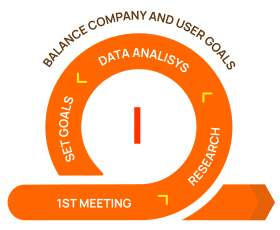
KNOWLEDGE
Understanding Company Goals, Medium-Term Objectives, Competitive Landscape, and User Requirements.
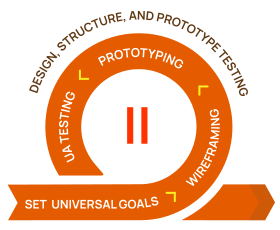
IDEATION
Defining UPO Goals, Structuring Project, Establishing Design Guidelines, High-End Mockups, Testing Prototypes.
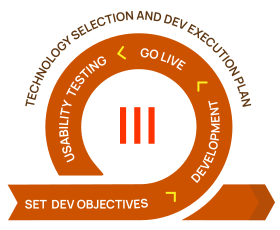
NEW TECHNOLOGY
Development Objectives, Team Briefing with UPOs, Agile Methodology Implementation and Dev Plan Execution.
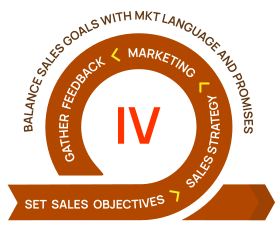
GROWTH
Develop Core Sales Strategies, Select Distribution Channels, Outline MKT Strategies, Execute and Gather Feedback.
K.I.N.G. Phases
A deep dive into each stage of the K.I.N.G. Methodology
Knowledge
Stage I is defined by the balance between company goals and user goals. It seeks to avoid two common extremes: building a product that only fulfills internal business objectives and ignores user reality, or letting user desires dictate the roadmap without considering sustainability. Either scenario leads to failure—low adoption on one end, business risk on the other.
Here, the work revolves around deep understanding: company objectives, competitive pressure, operational processes, and real user behavior. Through field research, interviews, data analysis, and observation, this stage establishes a shared understanding of the problem and the constraints that shape it.
Outcome: aligned goals, validated requirements, and a foundation strong enough to move into creation without guesswork. Stage I ensures the entire project begins grounded, not improvised.
Ideation
Stage II transforms the insights from Stage I into a functional, testable prototype. This is not “design for aesthetics”—it is the deliberate construction of a working model that mirrors how the future product is supposed to behave.
This stage includes all the foundational work that makes a prototype meaningful: defining user stories, structuring user flows, mapping needs and edge cases, shaping the UI and UX according to where and how the system will be used, and establishing navigation patterns suited to real-world scenarios.
The prototype is then tested in the field with real users. Feedback becomes the compass. Usability issues are corrected, flows are refined, and adjustments continue until UAT and usability testing show that the solution is both intuitive and functional.
Stage II prevents the classic trap of building fully coded software before validating whether people can—or want to—use it. Instead, it creates a high-confidence blueprint for development.
Outcome: aligned goals, validated requirements, and a foundation strong enough to move into creation without guesswork. Stage I ensures the entire project begins grounded, not improvised.
New Technology
Stage III bridges design and reality. With the validated prototype in hand, the focus shifts to choosing the right technology—one that fits the company’s constraints, the users’ needs, and the project’s long-term sustainability. It is not about chasing trends; it is about selecting tools and architectures that can reliably support what has been discovered and validated.
This stage evaluates technical options, performs feasibility checks, and defines the development plan with precision. Once technology is selected, the prototype becomes a real product through an agile, iterative process.
As in Stage II, UAT returns. The implemented version is tested again to confirm that the real system behaves as effectively as the prototype. Adjustments continue until performance, usability, and functionality align with expectations.
Stage III turns validated ideas into working software—intentionally, not experimentally.
Growth
Stage IV is where most companies fail—not because they lack talent, but because they believe “launch” is the finish line. In reality, delivery is only the midpoint. Growth requires maintaining the same discipline seen in the earlier stages: balance between the product’s capabilities, marketing language, and sales promises.
This stage focuses on scaling the product responsibly: establishing growth strategies, selecting distribution channels, aligning marketing messages, and supporting adoption without exaggeration. Overpromising (“this app will change your life,” “this system will cut your work to five minutes”) damages reputation, erodes trust, and kills long-term revenue.
Growth relies on evidence: validating what the product actually does, measuring user adoption, optimizing onboarding, and ensuring the promises made publicly reflect the real experience users will have.
Stage IV is about sustainable expansion—not hype—and is essential for long-lasting success.
Why This Methodology Matters
The K.I.N.G. Methodology offers a complete, balanced, and evidence-driven path to building digital products. It avoids the chaos of assumption-based development, the risk of misaligned goals, and the costly rework that comes from skipping research or testing. It turns the product lifecycle into a structured loop where every step is validated before moving forward.
Teams that adopt K.I.N.G. gain clear alignment, validated prototypes, appropriate technology choices, and a realistic growth strategy. Teams that ignore these principles often deliver software that “launches,” but doesn’t succeed—products that look good in presentations but fail in the hands of real users.
Following K.I.N.G. means building with intention: balancing company and user goals, testing before coding, choosing technology wisely, and growing without overpromising. It transforms the development process from uncertain and reactive into strategic, predictable, and ultimately more profitable.
Impact & Results
Message: Focus on two levers today—see compounded results in 90–180 days.